


Tests of the prototypes
It arises from the tests that, in its most powerful form (below), the prototype
makes it possible to go 10 to 15% faster.
What represents an increase in the output of more than 50% ! (as if there were a third fin !)
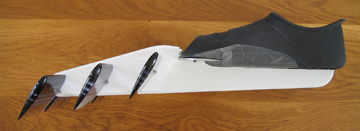
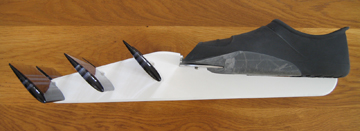
First contact :
The first contact is rather strange because we have the impression of not having anything on the foot. In statics, we have to change our practices.
No more foot like a coat rack to rest, we need to fin. But it is still comfortable and makes it possible to stay much longer in
lift. Especially when it is necessary to put the body out of water.
When we start to advance, if we let owrselves go in the same movement that a traditional fin, there is
so much little resistance that the foot goes easily too much ahead. There is almost the impression to make an effort to retain it. After some
tens meters, the good movement is found but there is almost the impression of making no effort, and although we move forward.
Once made a few hundred meters, and the movement is well assimilated, we can start to accelerate.
At full speed, they remain very comfortable, we feel a fluid movement, constant, there is no hard point, and we
feel immediately that we go more quickly !
Meeting of timed tests :
The tests were held, standing start, and timed on 20m. Each candidate carried out two sprints with his fins.
Then, after 200m of training with the prototypes, carried out two or three sprints.
After studying the times, it comes out from it a systematic improvement from 10% to 15%.
In all the duels, whatever the fin adversary, the swimmer with the prototypes always arrived first.
(however was the apprehension to damage the prototypes, and little training)
You can see, below, four filmed duels :
With which output that does correspond ?
Let us compare the average times carried out by the same swimmer with AvantiQuattro Power and then with the prototype :
Timed on a distance from 20m, this average time is of 14,2s with Quattro against 12,3s with the prototype (that is to say 13% less).
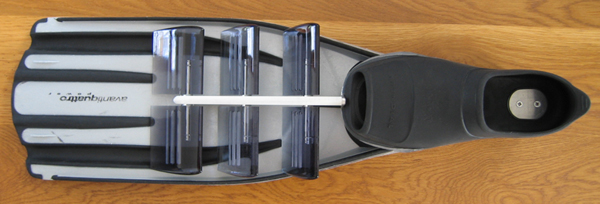
One can say that the Force of resistance of water is proportional to the square Speed,
that is to say : F=k . S² (k being the coefficient of friction).
The power consumption to fight against it is this force which multiplies the traversed Length,
therefore W = k .S² . L
Quattro : S= 20m/14,2s that is to say W = k . (20/14,2)² . 20 = 39,67 k
Prototype : S = 20m/12,3s that is to say W = k . (20/12,3)² . 20 = 52.87 k
The energy which one provides, it is the Power which one able is multiplied by the time of finning, that is to say :
Quattro : E = P.14,2s
Prototype : E = P.12,3s
The Output, it is the energy provided to the water divided by energy that one provided, that is to say :
Quattro : O = W/E = 2,79 k/P
Prototype : O = W/E = 4,30 k/P
If it is admitted that k and P are the same ones in both cases (k, because nobody changed body during the tests ;)
and P because everyone always swam “whole heartedly”, without any reserve), it is seen
that Op/Oq = 1,54.
The prototype with thus an output of 54% superior to Quattro !
Conclusion :
It is undeniable that this prototype is very powerful to advance quickly and a long time under water. On the other hand, on the surface,
its performances are less. Moreover, in "on the spot" or at low speed, one does not have support sufficiently to maintain us comfortably
at the horizontal.
It would be interesting to be able to carry out other tests with “true” swimmers and to thus compare the prototype with competition fins.


All that this site contains cannot be used without the agreement of the owner.
- Palmaile the fin with wings -